/
Event: Hektor meets Dexter Sinister
Place: Swiss Institute, New York
Date: 6 September 18:00 - 24:00, 2007


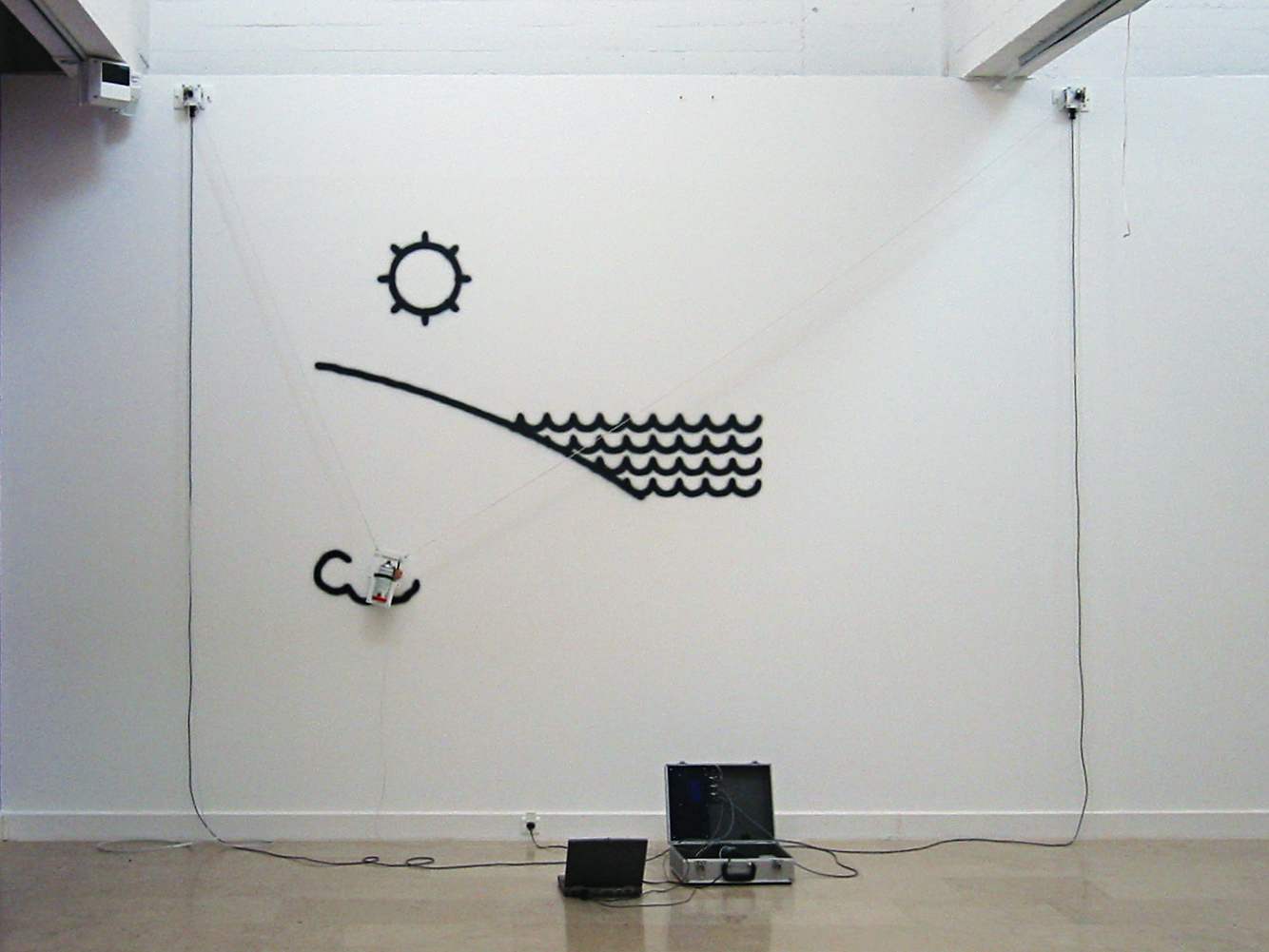
In collaboration with Dexter Sinister, Hektor was used to reproduce 8 Lissajous curves in the exhibition space and hallway of the Swiss Institute in New York.

The Lissajous curve is a mathematicsal term, coined by Jules Antoine Lissajous in 1857. It describes a curve that results from two haramonic oscillations of which one controls the X and the other the Y movement. The resulting figures span from simple to complex, through a range of basic types, all depending on wether the two oscillations are harmonic or out of sync.

In mathematics terms, a Lissajous curve is the graph of the system of parametric equations which describes complex harmonic motion:

x = Asin(at + δ)
y = Bsin(bt)

There is a link between these curves and Hektor's way of working. As Hektor draws any one of these figures, it has no extra motion. Every time Hektor moves it is painting because of the sine and cosine nature of these shapes. And just as any Lissajous curve, Hektor's motion can be described as two values x, y (the length of the belts) as a function of t (time).

During the show, microphones where used to record up the high pitched, sometimes screaming sounds of the stepper motors and amplify them back into the room, as a sort of mise en abyme. These sounds are yet another form of describing Hektor's movements and create again complex harmonies when mixed in the room.

en.wikipedia.org/wiki/Lissajous_curve